


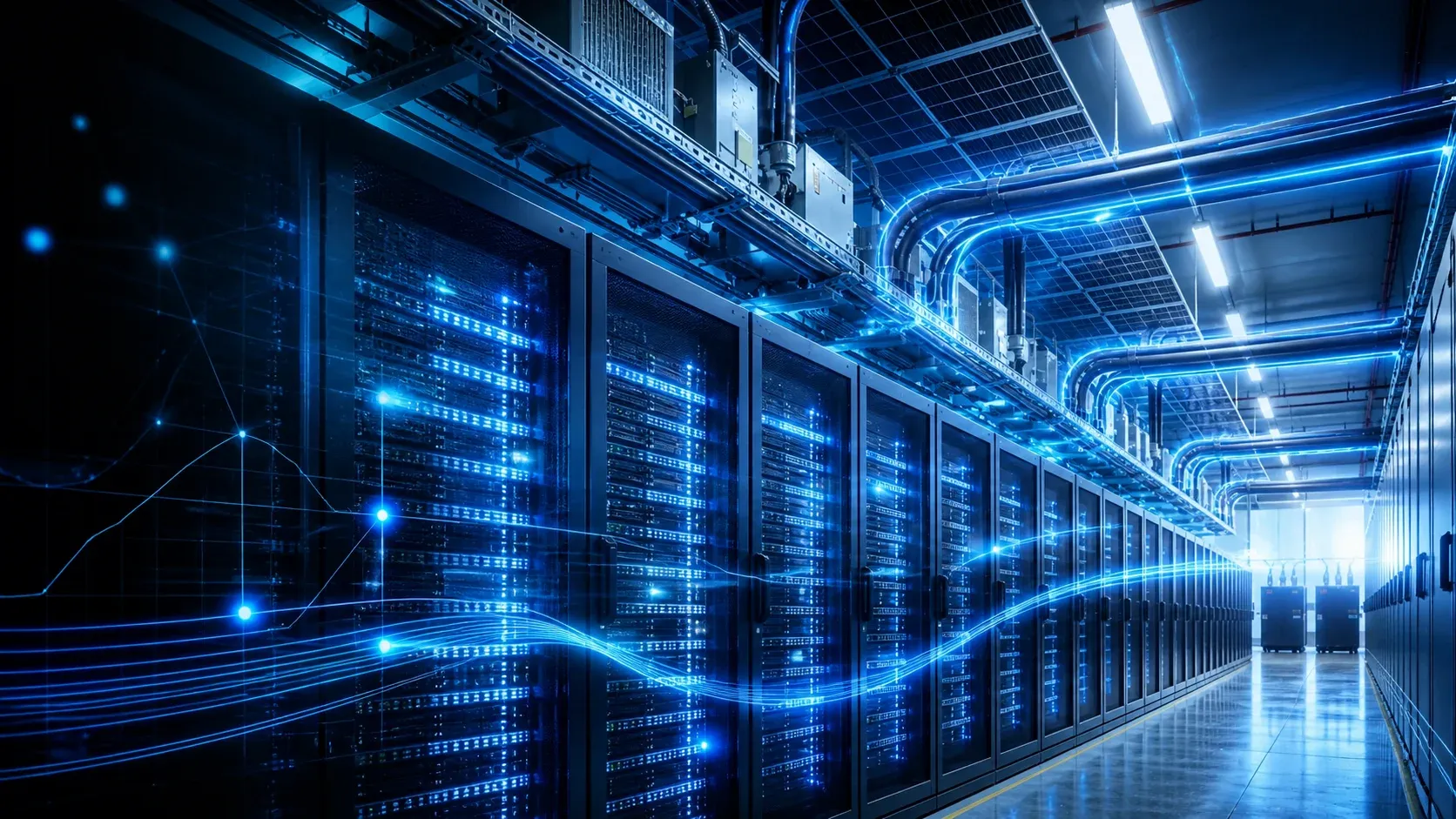
Artificial intelligence is not only changing software. It is changing electricity markets.
As cloud providers, AI companies, and enterprises build larger data centers, electricity demand is rising in places where grids were not designed for such concentrated load growth. This is turning power availability into a core business constraint for the digital economy.
The U.S. Energy Information Administration said electricity demand in the United States has been rising steadily since 2020 after more than a decade of limited growth. It identified electricity use by data centers as a key driver of that growth.
Data Centers Are Turning Into Grid-Scale Loads
Modern AI data centers are not ordinary office buildings. They require massive and reliable power for servers, cooling systems, networking equipment, backup systems, and high-density computing workloads.
The EIA expects the fastest electricity load growth through 2027 in ERCOT, which manages most of Texas, and PJM, which covers parts of the Mid-Atlantic and Midwest. These regions are already central to U.S. data center development.
In the EIA’s February Short-Term Energy Outlook baseline, U.S. electricity load was forecast to rise by 1.9% in 2026 and 2.5% in 2027. The agency also noted that ERCOT and PJM are expected to see particularly fast growth, with annual electricity load averaging 10% and 3% growth respectively between 2025 and 2027.
This creates a new planning problem. Data centers can be approved, financed, and built faster than transmission lines, substations, or new power plants. If demand arrives faster than supply, the result can be higher wholesale prices, delayed interconnections, or reliability pressure.
AI Could Lift Fossil Generation in High-Demand Scenarios
Data center growth does not automatically mean fossil fuel growth. But if electricity demand rises faster than clean energy and grid capacity, fossil generation may fill the gap.
The EIA modeled a high-demand scenario in which electricity demand growth is stronger than expected because of data centers and large loads. Reuters reported that under that scenario, U.S. natural gas generation could rise 7.3% from 2025 to 2027, compared with 1.7% under the baseline. Coal generation would still decline, but more slowly.
This is the tension at the center of the AI energy story. Technology companies want low-carbon electricity, but the speed of AI infrastructure deployment can collide with the slower buildout of grid and generation assets.
The Global Data Center Power Curve Is Rising
The pressure is not limited to the United States.
The International Energy Agency projects that global electricity consumption from data centers will double to around 945 TWh by 2030 in its base case. That would represent just under 3% of global electricity consumption in 2030.
The IEA also projects data center electricity consumption to grow around 15% per year from 2024 to 2030, more than four times faster than electricity consumption growth from all other sectors. Accelerated servers, mainly driven by AI adoption, are projected to grow electricity consumption by 30% annually.
This makes AI power demand a global infrastructure issue. The largest regions for data center electricity demand are expected to remain the United States, China, and Europe, while Southeast Asia is also becoming more important because of growth around Singapore and southern Malaysia.
Why Energy Companies Should Pay Attention
For utilities, grid operators, power developers, and equipment suppliers, data centers are becoming one of the most attractive and complicated demand sources.
They are attractive because they create long-term, high-volume electricity demand. They are complicated because they require reliability, speed, clean power claims, and often specific geographic locations.
This creates opportunities in several areas:
- transmission and substation upgrades
- gas-fired backup and firm generation
- battery storage and long-duration storage
- renewable power purchase agreements
- on-site generation
- grid software and load forecasting
- cooling and energy efficiency technologies
The market is shifting from simple “power supply” to integrated energy infrastructure planning.
What This Means for B2B Buyers
Data center operators and enterprise AI users will need to treat energy as part of their technology strategy.
A cloud region without enough power cannot scale. An AI workload without reliable electricity cannot serve customers. A data center without grid interconnection may remain a construction project instead of a revenue-generating asset.
For industrial buyers, the rise of data center demand may also affect local power prices and grid access. In constrained regions, large AI loads may compete with factories, warehouses, and other commercial users for electricity infrastructure.
The Business Takeaway
The AI boom has created a new energy equation: compute demand is becoming power demand.
Data centers are now shaping grid planning, electricity prices, fuel demand, and clean energy procurement. For energy companies, this is a major growth opportunity. For technology companies, it is a constraint that cannot be solved with software alone.
The winners will be companies that can connect compute, power, grid infrastructure, and sustainability in one strategy.
FAQ
Why are data centers increasing electricity demand?
AI workloads require high-density computing infrastructure, which consumes large amounts of electricity for servers, cooling, and supporting systems.
Which U.S. power regions are most exposed to data center growth?
The EIA expects ERCOT and PJM to experience the fastest electricity demand growth from data centers through 2027.
Could AI increase fossil fuel generation?
Yes, in high-demand scenarios where electricity demand rises faster than new generation capacity, natural gas generation may increase to meet demand.
Sources
- U.S. Energy Information Administration: Fossil generation could rise with faster-than-expected growth in data center power demand — use for U.S. power demand, ERCOT/PJM load growth, gas generation, and price risk.
- IEA: Energy demand from AI — use for global data center electricity demand projections through 2030 and regional growth.
- Reuters: U.S. power demand surge from data centers could lift fossil fuel generation — use as third-party reporting around EIA’s data center demand warning.
- Reuters: U.S. power use to beat record highs in 2026 and 2027 — use for wider U.S. power demand forecast context.
