The surge in artificial‑intelligence (AI) workloads is driving a rapid expansion of hyperscale data centers, but water availability is emerging as a critical bottleneck. Gradiant’s HyperSolved™ platform, now deployed with several of the world’s largest hyperscale operators, promises to consolidate the fragmented water‑cooling supply chain into a single, accountable system. For utilities, permitting authorities, and investors, the solution signals a shift in how water infrastructure will be planned, financed, and regulated alongside power and land resources.
Water Constraints in the AI‑Driven Data Center Boom
Industry forecasts predict a six‑fold increase in global data‑center capacity between 2025 and 2035. Unlike traditional compute facilities, AI‑focused campuses demand substantially higher power densities, which translate into proportionally higher cooling loads. Gradiant estimates that a 100 MW hyperscale campus can consume water equivalent to the daily usage of an 80,000‑person city. In many jurisdictions, water scarcity, complex permitting processes, and strict discharge limits already restrict site selection and expansion timelines. Operators therefore face a three‑fold risk: (1) inability to secure reliable water supplies, (2) heightened regulatory exposure, and (3) operational downtime stemming from fragmented vendor management.
HyperSolved: An End‑to‑End Water‑Infrastructure Platform
HyperSolved integrates the entire cooling‑water lifecycle—from sourcing to treatment, distribution, and discharge—into a single platform delivered by Gradiant. Key technical elements include:
- Alternative water sources such as municipal reuse and impaired supplies, reducing dependence on freshwater.
- Integrated treatment using Gradiant’s CURE Chemicals and SmartOps AI, which maintains cooling performance while minimizing contaminants.
- High‑recovery concentration and reuse that lower discharge volumes, easing compliance with local effluent standards.
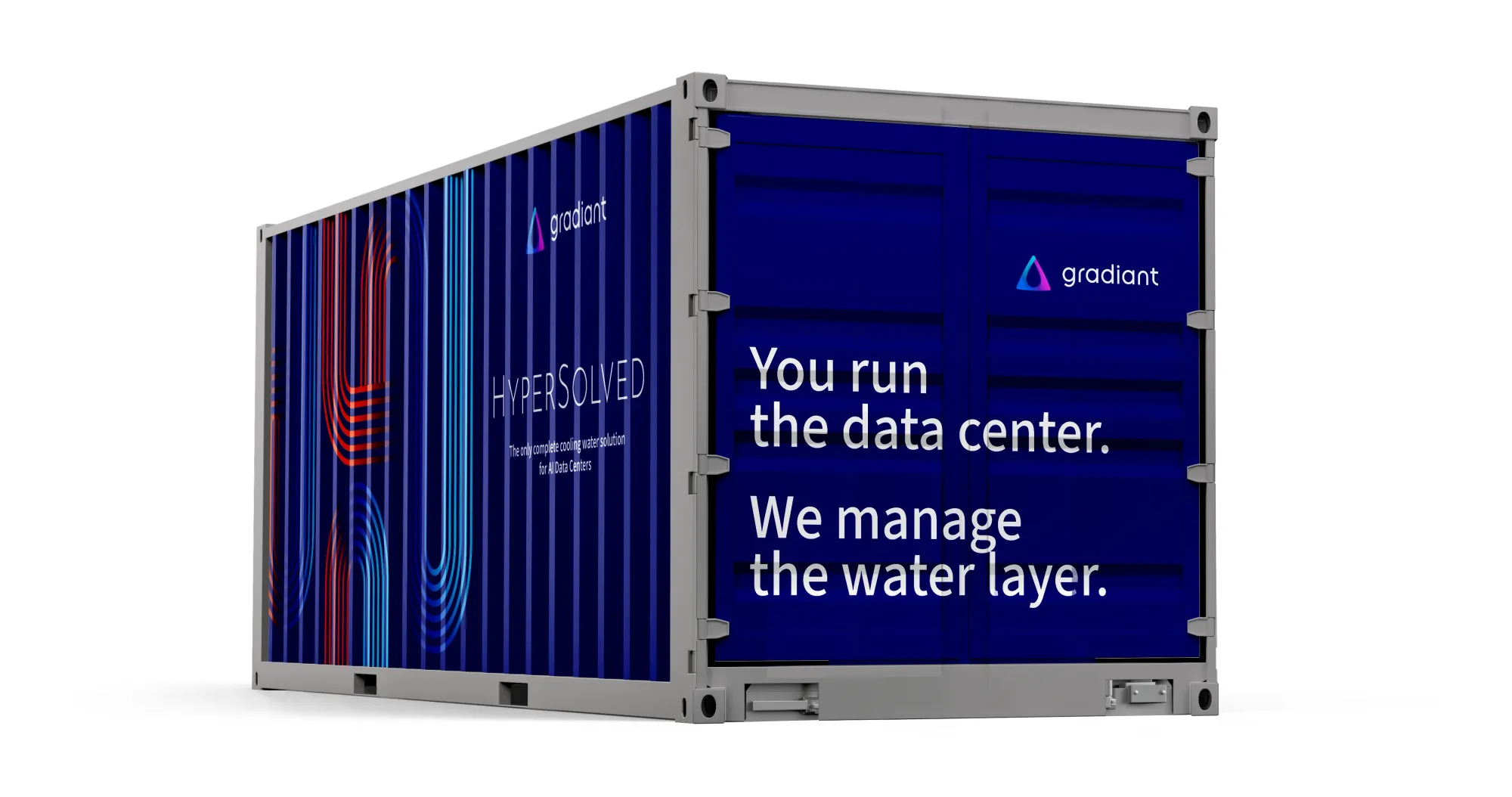
- Containerized, modular deployment that can be installed rapidly for temporary capacity or scaled into permanent infrastructure.
CEO Prakash Govindan framed the offering as a response to “a once‑in‑a‑generation build‑out of AI infrastructure,” likening its scale to the 19th‑century railroad expansion. Head of Special Projects Sankar Natarajan emphasized the operational model: “You run the data center. We manage the water layer,” positioning water as a utility‑grade service with comparable reliability expectations.
Gradiant reports strong commercial uptake among leading hyperscalers and projects that data‑center projects will account for roughly 25 % of its global revenue by 2027. The platform is available across North America, Europe, the Middle East, and Asia, targeting hyperscalers, data‑center developers, and engineering partners.
Strategic Implications for Utilities, Regulators, and Investors
Utility Planning and Capacity Allocation
Utilities that traditionally provision electricity now must consider water as a co‑limiting resource for AI‑heavy sites. Integrated solutions like HyperSolved can reduce the need for new freshwater withdrawals, allowing utilities to allocate existing water rights more efficiently and defer costly new intake infrastructure.
Permitting and Environmental Compliance
By consolidating treatment and discharge under a single accountable partner, HyperSolved simplifies the permitting process. Regulators can engage with one entity rather than a patchwork of vendors, potentially accelerating approvals while ensuring that high‑recovery technologies meet effluent standards.
Capital Expenditure and Risk Management
The modular, containerized design shortens construction cycles, translating into lower upfront capital commitments and reduced exposure to construction‑related delays. For investors, the ability to scale water infrastructure in tandem with power and rack deployments de‑risks the overall project economics, especially in regions where water scarcity commands premium pricing.
Supply‑Chain Resilience
A single‑source water solution mitigates the risk of vendor fragmentation, which can lead to mismatched equipment specifications and maintenance gaps. This integrated approach aligns with broader industry moves toward end‑to‑end asset management platforms that cover power, cooling, and now water.
Key Takeaways
- AI‑driven data centers could consume water comparable to an 80,000‑person city per 100 MW campus, making water a decisive factor in site selection.
- Gradiant’s HyperSolved consolidates sourcing, treatment, and discharge into a single platform, leveraging alternative water supplies and AI‑optimized treatment to lower freshwater demand and discharge volumes.
- Integrated water management can streamline permitting, reduce capital risk, and align utility water planning with the rapid expansion of AI infrastructure.
EnergyInsyte's Take
As AI workloads push data‑center power densities to new heights, water will increasingly dictate where and how facilities can be built. Gradiant’s HyperSolved offers a pragmatic response by turning water into a managed, utility‑grade service rather than a fragmented afterthought. For utilities, regulators, and investors, the platform presents an opportunity to address water scarcity, simplify compliance, and protect capital investments—all while supporting the next wave of AI‑enabled digital transformation.
Source: Businesswire