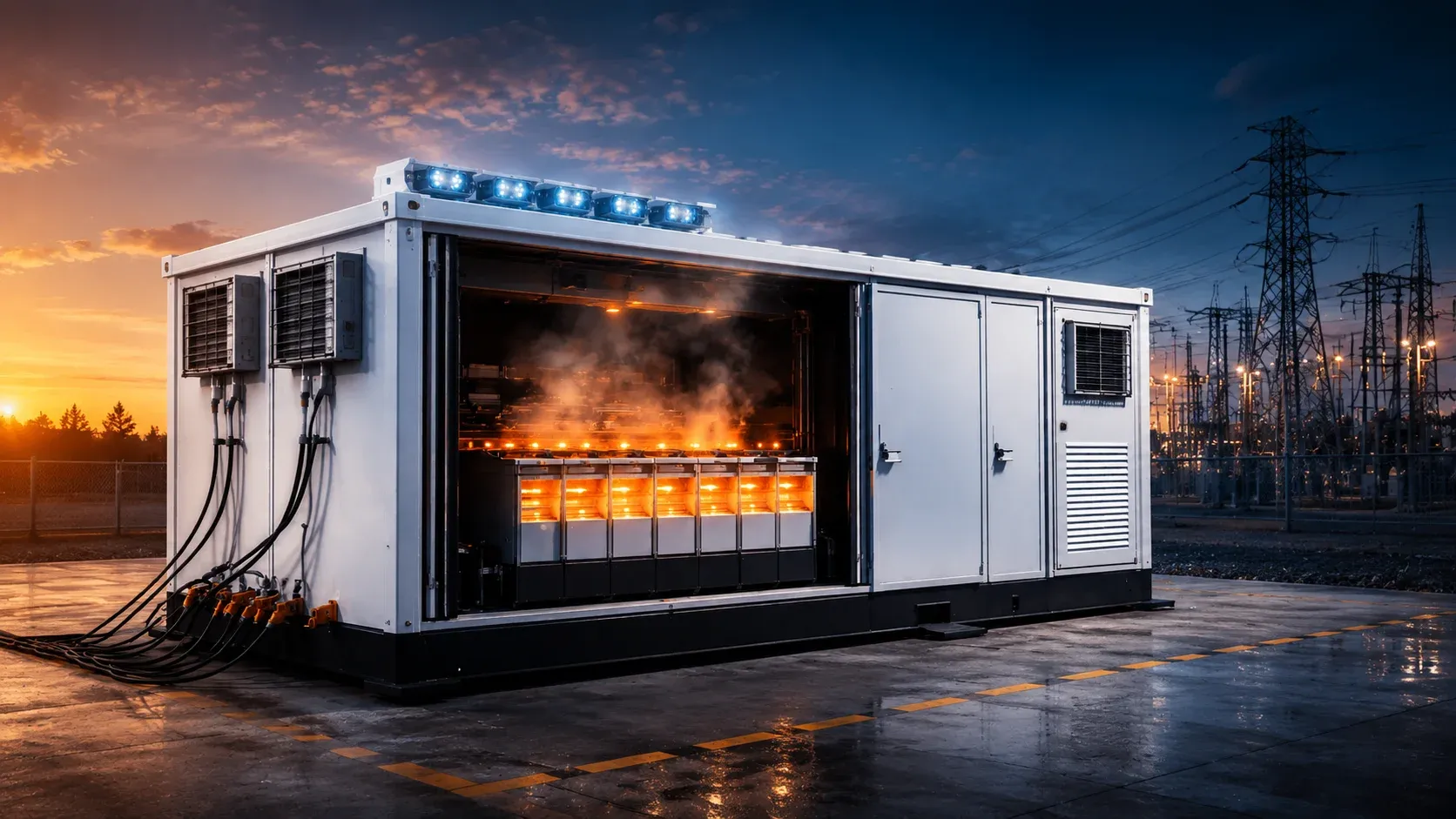
Myers Emergency & Power Systems announced that its EnerShed 2.0 battery energy storage system (BESS) successfully completed the UL 9540A Large‑Scale Fire Test 6th Edition, administered by CSA Group. The air‑cooled system was tested with units spaced only two inches apart and showed no fire propagation, marking the first such certification for a BESS in North America.
The Update
Myers’ EnerShed 2.0 passed the UL 9540A Large‑Scale Fire Test 6th Edition in March 2026, conducted by CSA Group at Safe Laboratories with observation from independent fire‑protection experts, including Atar Fire. The test required the system to demonstrate that a thermal‑runaway event in one enclosure would not spread to adjacent units under the new standard’s LSFT (Large‑Scale Fire Test) criteria. Myers’ air‑cooled architecture, passive barriers and open‑module design met the most stringent outcome defined by the standard—no fire propagation.
Chief Product Officer Troy Renken emphasized that safety “is not a checkbox” and that the result “cements Myers’ position as an emerging market leader in the BESS category.” CSA Group’s Commercial Vice President Dana Parmenter noted that the 6th Edition, published in March 2026, formally integrates LSFT testing, making large‑scale fire data essential for permitting and insurance.
Infrastructure Context
The UL 9540A 6th Edition introduces the first formal requirement for BESS manufacturers to prove fire containment between closely spaced units. Utilities, developers and authorities having jurisdiction (AHJs) increasingly demand such data to approve projects, especially in dense urban or industrial sites where space constraints force tight module placement. By demonstrating compliance with the new LSFT requirement, EnerShed 2.0 reduces a key risk factor that has historically slowed BESS deployment.
Myers’ air‑cooled, passive‑barrier design contrasts with many liquid‑cooled competitors, which often rely on active cooling and may face different fire‑risk assessments. The successful test validates that an open‑door, air‑cooled system can meet the heightened safety expectations without sacrificing performance.
Market Signal
Achieving the first UL 9540A 6th Edition certification in North America sends a clear signal to insurers, financiers and project developers that Myers’ BESS technology aligns with the latest regulatory expectations. As AHJs and insurance underwriters incorporate LSFT results into permitting and underwriting criteria, certified systems are likely to experience faster approval timelines and potentially lower insurance premiums.
The milestone also positions Myers to differentiate its offering in a crowded BESS market where safety certifications are becoming a competitive prerequisite. Developers seeking to mitigate permitting risk may prioritize systems with documented large‑scale fire performance.
Execution Questions
- Supply Chain Impact: Will the air‑cooled, passive‑barrier architecture require different component sourcing compared with liquid‑cooled designs, and how might that affect lead times?
- Scalability: The test used units spaced two inches apart; can the same safety performance be maintained at larger commercial scales or with different layout configurations?
- Regulatory Adoption: How quickly will AHJs across jurisdictions adopt the UL 9540A 6th Edition LSFT requirement as a mandatory criterion for BESS permits?
- Insurance Pricing: Will insurers adjust premium structures for projects using UL 9540A‑certified systems, and what timeline is expected for such pricing changes?
Key Takeaways
- Myers’ EnerShed 2.0 became the first BESS in North America to pass the UL 9540A 6th Edition Large‑Scale Fire Test, demonstrating no fire propagation with units spaced two inches apart.
- The UL 9540A 6th Edition, released March 2026, now mandates LSFT compliance, making large‑scale fire data a critical factor for permitting, insurance and financing.
- Successful certification could accelerate project approvals and reduce insurance costs for developers that adopt EnerShed 2.0, while raising questions about supply‑chain implications and broader regulatory adoption.
EnergyInsyte's Take
For utilities, developers and investors, Myers’ certification provides a tangible data point that addresses a historically opaque risk—fire propagation in tightly packed BESS installations. Decision‑makers should monitor how quickly AHJs incorporate the LSFT requirement into their permitting frameworks and whether insurers begin to reflect the certification in premium calculations. Equally important is assessing whether Myers can sustain the demonstrated safety performance at utility‑scale deployments and across varied site configurations. Until broader regulatory and market adoption is evident, the EnerShed 2.0 milestone should be viewed as a strong safety validation that may de‑risk future BESS projects, but not a guarantee of accelerated rollout on its own.
Source: Businesswire