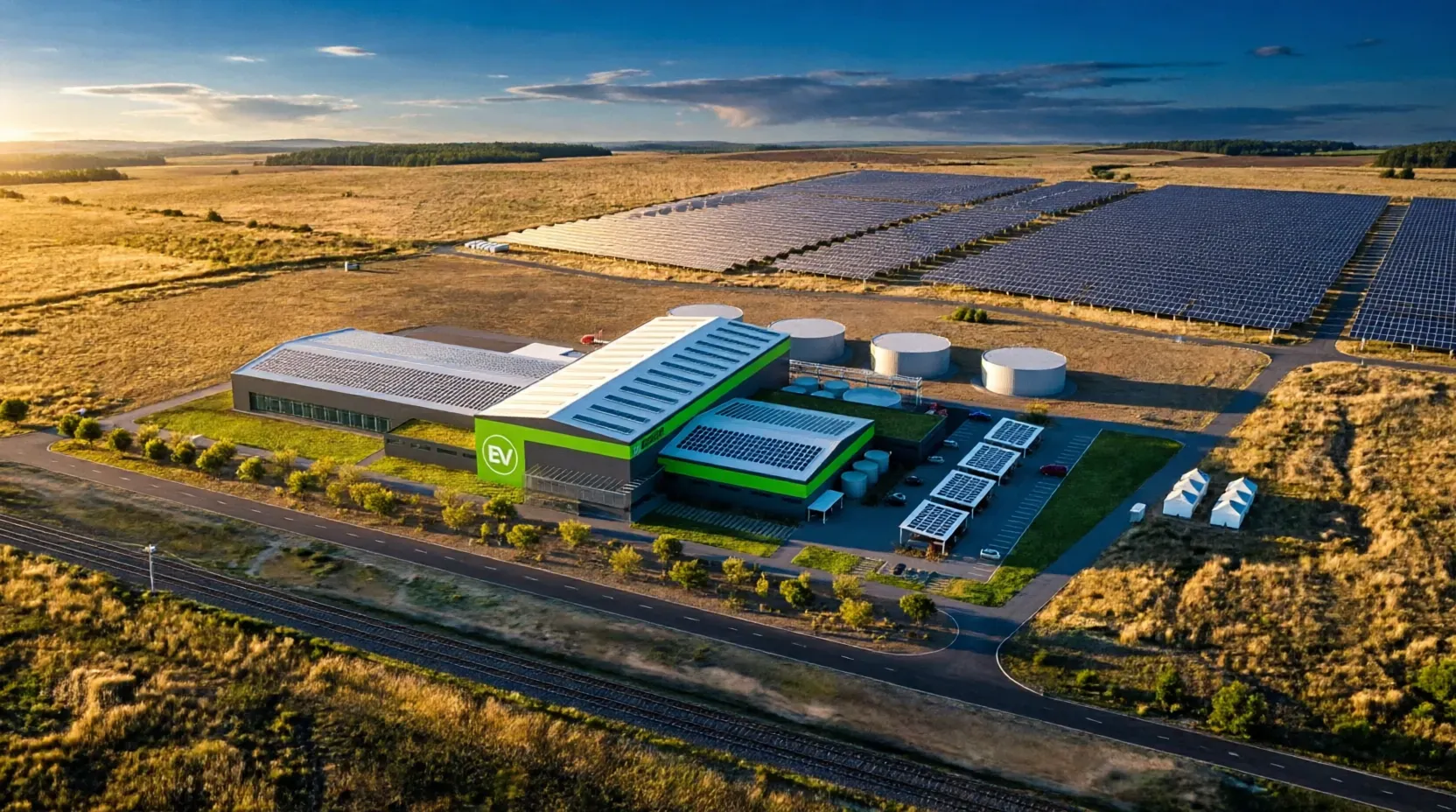

Solar power is becoming the default growth engine of the global energy transition.
In 2025, renewable power capacity increased by 692 GW, the largest annual increase on record. IRENA reported that approximately three-quarters of that expansion came from solar energy, which increased by 511 GW, while wind added 159 GW. Solar and wind together accounted for 96.8% of all net renewable additions.
This is not only a China, Europe, or U.S. story. Emerging markets are increasingly shaping the next stage of solar growth.
Solar Is Winning Because It Is Fast, Modular, and Cost-Competitive
Solar has structural advantages that matter in emerging markets.
It can be deployed at multiple scales: rooftop systems, commercial and industrial installations, utility-scale parks, agricultural pumps, mini-grids, and hybrid projects with batteries. It can also be built faster than many conventional power plants and often faces fewer construction complexities than large thermal, hydro, or nuclear assets.
The IEA expects solar PV to account for around 80% of the global increase in renewable power capacity over the next five years, driven by low costs and faster permitting timelines. The agency also says renewables are expanding faster in emerging economies across Asia, the Middle East, and Africa due to cost competitiveness and stronger policy support.
That combination makes solar especially attractive for fast-growing economies that need power quickly.
India Is Becoming a Major Solar Growth Market
India is central to the emerging-market solar story.
IRENA’s 2026 capacity highlights show that Asia added 371.2 GW of solar capacity in 2025, with China contributing 315.1 GW and India adding 37.0 GW.
The IEA also says India is on course to become the second-largest renewables growth market globally after China and is expected to comfortably reach its ambitious 2030 target.
For India, solar is not only a climate tool. It is an energy security and industrial strategy. Solar can reduce dependence on imported fuels, support industrial parks, power agricultural demand, and supply fast-growing urban and commercial loads.
The challenge is grid readiness. Solar growth must be matched with transmission, distribution upgrades, storage, forecasting, and flexible demand.
Africa’s Solar Market Is Entering a Breakout Phase
Africa remains a small share of global solar capacity, but growth is accelerating.
Reuters reported that Africa installed a record 4.5 GW of photovoltaic solar capacity in 2025, a 54% increase from the previous year, according to the Global Solar Council. Eight African countries added at least 100 MW of solar capacity, double the number that reached that threshold in 2024.
Reuters also reported that South Africa has the largest solar footprint on the continent, with capacity likely just above 10 GW after adding 1.6 GW in 2025. North African countries including Egypt, Algeria, Morocco, and Tunisia added 1.1 GW in 2025, while Nigeria installed a record 803 MW.
This matters because Africa has enormous solar resource potential but historically low deployment. Falling module costs, policy reforms, storage imports, and private-sector demand are beginning to change that.
Batteries Are Becoming Part of the Solar Story
Solar’s rapid growth creates a second market: storage.
Reuters reported that African nations sharply increased imports of battery energy storage systems in 2025 to help utilities, households, and businesses maximize solar power availability after dark. African nations bought a record $2 billion of China-made solar modules and $2.6 billion of China-made battery systems in 2025, according to data cited by Reuters.
This is a crucial shift. In emerging markets, solar plus storage can address not only decarbonization, but reliability.
Businesses that face power outages, weak grids, or high diesel-generator costs may adopt solar-plus-battery systems for energy resilience. That creates opportunities for EPC firms, inverter manufacturers, battery suppliers, C&I developers, financiers, and energy-management software companies.
The Middle East and Southeast Asia Are Also Moving Faster
The IEA says solar growth is set to surge in economies such as Saudi Arabia, Pakistan, and several Southeast Asian countries. It also says emerging economies across Asia, the Middle East, and Africa are seeing faster renewable growth because of cost competitiveness, stronger policy support, new auction programs, and higher targets.
This is important because the global solar market is becoming more geographically diverse.
The Middle East has world-class solar resources and growing demand from industry, desalination, data centers, green hydrogen plans, and domestic power needs. Southeast Asia has rising industrial power demand, manufacturing growth, and increasing interest in corporate renewable procurement.
Pakistan’s solar surge shows another driver: when grid electricity is expensive or unreliable, distributed solar becomes a business decision, not only a policy choice.
The Deployment Gap Is Still Large
Despite strong growth, deployment remains uneven.
IRENA’s Renewable Capacity Statistics 2026 says that renewables accounted for 49% of global installed power capacity and 85.6% of annual global power additions by the end of 2025. But IRENA also notes major disparities: China, the United States, and the European Union together accounted for 550 GW, or 79.5%, of new renewable capacity installed in 2025, while Africa accounted for 11.3 GW, or 1.6%.
That imbalance is the core policy challenge.
Solar is expanding quickly, but the countries with the highest electricity-access and growth needs still need more financing, grid investment, storage, land-use planning, and bankable procurement structures.
Why This Matters for B2B Energy Markets
Solar’s dominance changes the business landscape.
For developers, emerging markets offer growth as mature markets become more competitive. For manufacturers, lower module prices may create volume opportunities in new regions. For financiers, the challenge is structuring bankable projects in markets with currency, offtaker, and policy risk. For industrial buyers, solar can reduce long-term power costs and improve energy resilience.
The biggest opportunities are likely to appear in:
- commercial and industrial solar
- utility-scale solar auctions
- solar-plus-storage
- distributed rooftop systems
- mini-grids
- agricultural solar
- industrial park power supply
- grid modernization
- energy management software
- local EPC and maintenance ecosystems
Solar is no longer a niche renewable option. It is becoming the base layer of new power capacity.
The Business Takeaway
Solar power is dominating renewable capacity additions because it solves practical energy problems: speed, cost, modularity, and scalability.
IRENA’s 2026 data confirms that solar accounted for the bulk of record renewable additions in 2025. The IEA expects solar to dominate renewable capacity growth through 2030. Reuters’ Africa reporting shows that emerging markets are beginning to accelerate from a lower base.
For EnergyInsyte readers, the key insight is simple: the next phase of solar growth will not be defined only by the largest mature markets. It will be shaped by fast-growing economies where solar is becoming the cheapest, quickest, and most flexible answer to rising power demand.
The sun is no longer just an energy source. It is becoming infrastructure policy with a bright yellow hard hat.
FAQ
How much renewable capacity was added globally in 2025?
IRENA reported that renewable power capacity increased by 692 GW in 2025, the largest annual increase on record.
How much of that growth came from solar?
Solar energy increased by 511 GW in 2025, accounting for approximately three-quarters of renewable capacity expansion.
Why are emerging markets important for solar growth?
Emerging markets need fast, affordable power. Solar’s low cost, modular deployment, and policy support make it attractive across Asia, the Middle East, and Africa.
Source Pack
- IRENA Renewable Capacity Highlights 2026: use for the 2025 global renewable capacity increase of 692 GW, solar’s 511 GW contribution, and solar/wind’s combined 96.8% share of net renewable additions.
- IRENA Renewable Capacity Statistics 2026: use for renewables accounting for 49% of global installed power capacity and 85.6% of annual power additions by the end of 2025.
- IEA Renewables 2025 forecast: use for solar PV accounting for around 80% of global renewable capacity growth over the next five years and growth across emerging Asia, the Middle East, and Africa.
- Reuters: Africa primed for solar breakthrough: use for Africa’s record 4.5 GW of solar PV additions in 2025, 54% year-on-year growth, and strong policy/component-cost drivers.